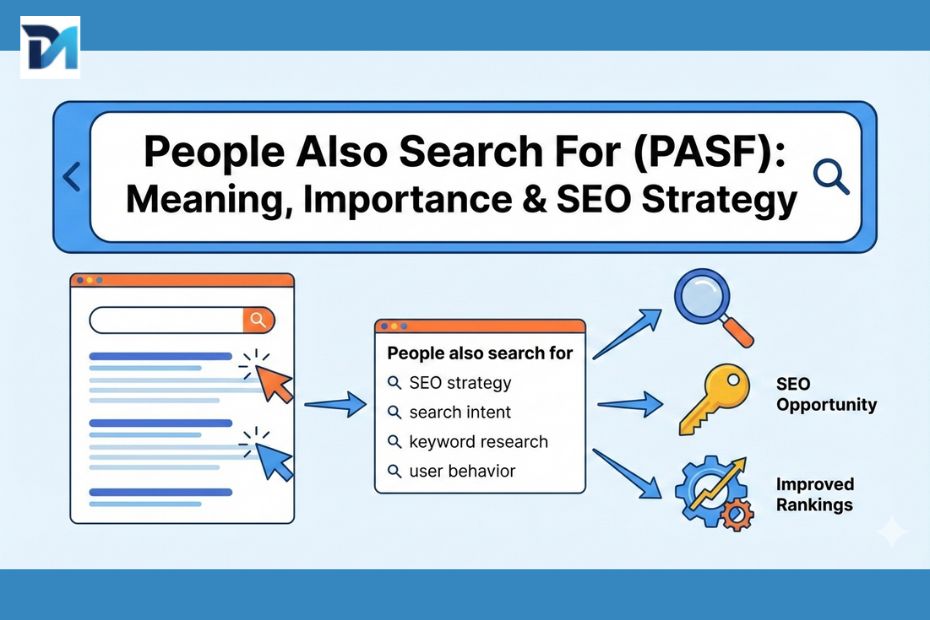
People Also Search For” (PASF) is a powerful yet underutilized Google SERP feature that reveals real user search behavior beyond the primary query.
This guide explains:
- What PASF is and how it works
- Why PASF matters for modern SEO
- How PASF influences user journeys
- How to use PASF for keyword research & content planning
- How PASF fits into AI-first SEO, SGE, and 2025 search trends
If you want content that ranks beyond just one keyword, PASF is your roadmap.
Table of Contents
- What is People Also Search For (PASF)?
- Where Does PASF Appear in Google SERPs?
- Why PASF Is Important for SEO
- How PASF Changes User Search Behavior
- Using PASF for Keyword Research (Step-by-Step)
- How to Optimize Content for PASF Visibility
- Best Tools to Track PASF Keyword Performance
- PASF in a Broader SEO & AI Search Strategy
- Challenges in PASF Optimization (and Solutions)
- Final Thoughts
1. What is People Also Search For (PASF)?
People Also Search For (PASF) is a Google SERP feature that displays related search queries users commonly explore after searching for—or clicking on—a result.
Unlike static keyword suggestions, PASF is:
- Behavior-driven
- Contextual
- Dynamic
- Search intent–focused
It reflects what users want next, not just what they searched first.
2. Where Does PASF Appear in Google SERPs?
PASF typically appears in two situations:
1️⃣ After Returning to SERP
When a user clicks a result and comes back, Google may show PASF suggestions related to the page they visited.
2️⃣ Below Search Results
Sometimes PASF appears near the bottom or mid-SERP alongside other features like “Related Searches.”
📌 Important: PASF results change based on:
- Location
- Device
- Search history
- Trending topics
- Real-time user behavior
3. Why PASF Is Important for SEO
PASF is not just a UX feature—it’s an SEO intelligence goldmine.
Key SEO Benefits of PASF
🔹 Discover Hidden Keywords
PASF reveals keywords users actually search—not just what tools predict.
🔹 Understand Search Intent Better
PASF queries often expose:
- Informational intent
- Comparison intent
- Purchase intent
- Problem-solution intent
🔹 Identify Long-Tail Opportunities
Most PASF terms are long-tail, lower competition, and higher intent.
🔹 Improve Topical Authority
Covering PASF topics helps Google see your content as complete, not partial.
🔹 SERP Feature Visibility
Optimized PASF content improves:
- Organic CTR
- Dwell time
- Topical relevance
4. How PASF Changes User Search Behavior
PASF plays a major role in shaping modern search journeys.
How Users Interact with PASF
- Search expansion: Users explore adjacent topics
- Query refinement: Vague searches become precise
- Discovery learning: New angles & subtopics emerge
- Longer sessions: Users stay within Google ecosystem
- Decision influence: Especially for products & services
📌 For SEO, PASF shows what content Google expects next.
5. Using PASF for Keyword Research (Step-by-Step)
Step 1: Start With a Seed Keyword
Example:
“SEO audit”
Step 2: Search on Google
- Click a result
- Return to SERP
- Note PASF suggestions
Step 3: Expand Recursively
Search each PASF term again and repeat.
Step 4: Validate With SEO Tools
Use:
- Google Search Console
- Ahrefs / SEMrush
- Keyword Planner
Check:
- Search volume
- Keyword difficulty
- Intent match
Step 5: Group by Intent
Create clusters like:
- Informational
- Commercial
- Transactional
This becomes your content map.
6. How to Optimize Content for PASF Visibility
✔ Create Topic-Complete Content
Don’t write for one keyword—cover:
- Related questions
- Subtopics
- Comparisons
- Use cases
✔ Use Natural Language
PASF favors conversational and intent-driven content, especially in AI search.
✔ Strengthen Internal Linking
Link PASF-related articles together using contextual anchors.
✔ Improve UX Signals
- Fast loading
- Mobile-friendly
- Clear structure
- Scannable sections
✔ Update Content Regularly
Freshness matters because PASF is trend-sensitive.
7. Best Tools to Track PASF Keyword Performance
🔧 Essential Tools
- Google Search Console – Real PASF-triggering queries
- Google Analytics – Engagement & conversions
- Ahrefs / SEMrush – Ranking & SERP features
- People Also Ask scrapers – For topic mapping
Metrics to Track
- Impressions
- CTR
- Avg. position
- Engagement
- Conversion paths
8. PASF in a Broader SEO & AI Search Strategy
PASF is critical for 2025 SEO, especially with:
- AI Overviews
- SGE (Search Generative Experience)
- Answer Engine Optimization (AEO)
- GEO & LLM visibility
PASF Supports:
- Topical authority building
- AI-friendly content structuring
- Entity-based SEO
- Conversational search optimization
📌 PASF = Bridge between classic SEO and AI-first search
9. Challenges in PASF Optimization (and Solutions)
| Challenge | Solution |
|---|---|
| Constant changes | Monitor SERPs monthly |
| Keyword volatility | Focus on topic clusters |
| High competition | Target long-tail PASF |
| Intent mismatch | Analyze SERP before writing |
| Tracking difficulty | Segment PASF queries in GSC |
10. Final Thoughts
People Also Search For is no longer optional—it’s foundational to modern SEO.
If your content:
- Answers only one keyword
- Ignores adjacent queries
- Lacks topical depth
👉 You’re already behind.
At DigiMark Solutions, we build SEO strategies that:
- Align with real user behavior
- Perform in AI-driven SERPs
- Scale with topical authority
Want to Dominate SERPs Beyond Just Rankings?
Let DigiMark Solutions help you build PASF-driven, AI-ready SEO strategies that convert traffic into growth.