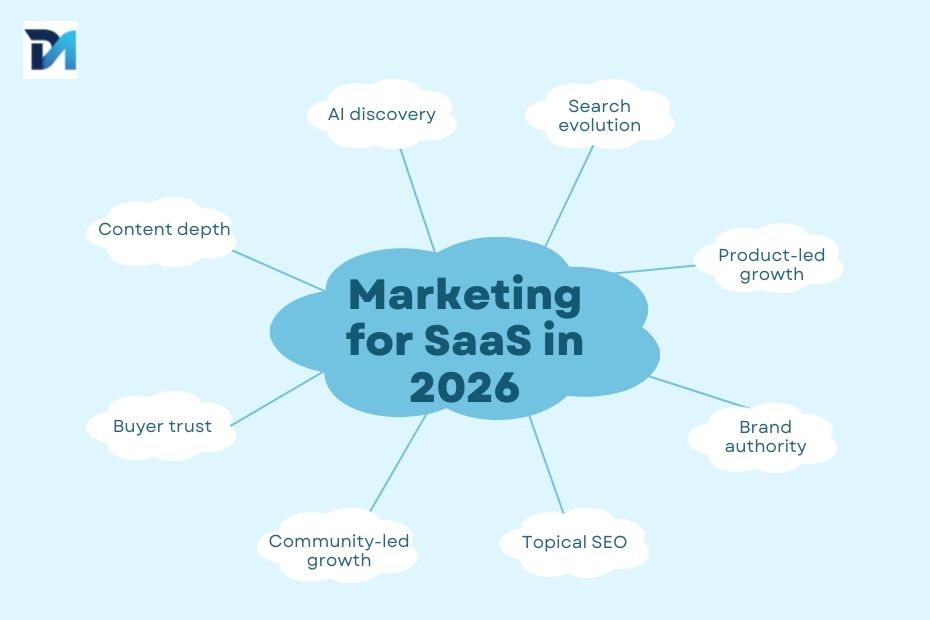
SaaS marketing in 2026 doesn’t feel dramatic on the surface.
There’s no single “new channel” everyone is rushing to. No overnight hack. No magic platform.
Instead, what’s happening is slower—and far more important.
The rules are shifting quietly, and many SaaS companies are still playing the old game without realizing it.
The Biggest Change: Buyers Don’t Enter Funnels Anymore
In earlier years, SaaS marketing was built around funnels. Awareness, consideration, conversion. Neat stages. Clean dashboards.
In reality, that’s not how people buy software anymore.
A typical SaaS buyer in 2026 might:
- Ask an AI assistant for recommendations
- Read two or three blogs without bookmarking them
- Watch a short clip on LinkedIn weeks later
- Compare tools on a random review site
- Visit your website multiple times without converting
By the time they finally book a demo, the “funnel” has already happened—just not inside your analytics.
Marketing today is less about guiding users forward and more about being present wherever the decision is forming.
AI Didn’t Kill Marketing. It Exposed Weak Marketing.
AI tools have flooded the internet with content. Blogs, landing pages, emails—all generated faster than ever.
What’s interesting is not how much content exists now, but how little of it actually sticks.
In 2026, AI hasn’t replaced marketers. It has exposed:
- Shallow positioning
- Copycat messaging
- Brands that never had a clear point of view
The SaaS companies doing well aren’t avoiding AI. They’re using it without sounding like it. Human thinking still leads. AI just assists.
SaaS Content Is Shifting from Keywords to Conversations
For a long time, SaaS content strategies were built around keywords.
In 2026, they’re built around questions, doubts, and real conversations.
People aren’t just searching:
“best CRM software”
They’re asking:
- “Is switching CRMs even worth it at my stage?”
- “What breaks first when a SaaS team scales?”
- “Why do most tools fail after onboarding?”
Content that answers these questions doesn’t feel like marketing—and that’s exactly why it works.
Brand Is Back, Just Not the Old Version of It
Brand marketing used to mean logos, taglines, and big campaigns.
In SaaS today, brand is built through:
- Consistency of thinking
- Repetition of useful ideas
- Familiarity across platforms
When someone sees your product mentioned on Google, explained in a blog, referenced by AI, and discussed on LinkedIn—it creates confidence without effort.
In 2026, brand is what people remember when they don’t remember where they heard about you.
Community-Led Growth Is Becoming Quietly Powerful
Another shift that’s easy to miss: SaaS growth is becoming less broadcast-driven and more community-driven.
Not massive public communities—but:
- Niche Slack groups
- Founder circles
- Operator-led discussions
- Comment sections that actually matter
SaaS brands that listen more than they talk tend to win here. Marketing teams are starting to behave more like observers than promoters.
SEO Still Matters, But Not the Way It Used To
Despite constant predictions, SEO hasn’t gone away.
What has gone away is low-effort SEO.
In 2026:
- Search engines reward depth over volume
- AI surfaces sources it “trusts,” not just ranks
- Thin content quietly disappears
SEO is no longer a checklist. It’s a reflection of how deeply a SaaS company understands its own market.
When SEO works today, it’s usually invisible. It supports everything else instead of acting as a standalone channel.
The SaaS Marketing Stack Is Simpler, Not Bigger
Interestingly, many SaaS companies are reducing tools instead of adding more.
The focus is shifting toward:
- Fewer platforms, better usage
- Cleaner attribution, fewer vanity metrics
- Content that compounds, not campaigns that expire
Marketing teams are spending less time launching and more time refining.
That’s not slower growth—it’s more sustainable growth.
What This All Means for SaaS Teams in 2026
SaaS marketing isn’t harder than before.
It’s just less forgiving.
You can’t fake relevance.
You can’t shortcut trust.
And you can’t rely on one channel to do all the work.
The brands that grow steadily are the ones that:
- Stay visible without being loud
- Educate without overselling
- Show up consistently, even when there’s no immediate ROI
Final Thought
Marketing for SaaS in 2026 feels less like “running campaigns” and more like earning a place in ongoing conversations.
When people finally decide they need a solution, they don’t start fresh. They choose from the brands that already feel familiar. That’s where real growth comes from.
If you’re a SaaS brand navigating these shifts, partnering with an experienced SEO company in India can help turn visibility into long-term growth.
FAQs
SaaS marketing in 2026 is less campaign-driven and more presence-driven. Buyers research across search engines, AI tools, social platforms, and peer discussions long before they convert. Marketing now focuses on visibility, credibility, and consistency rather than quick lead capture.
Yes, SEO still works, but it looks very different. Instead of targeting isolated keywords, SaaS SEO now focuses on topical depth, real use cases, and content that answers genuine user questions. Search engines and AI tools prioritize trust and expertise over volume.
AI is changing how people discover software, not just how content is created. Many buyers now use AI tools for research, comparisons, and recommendations. This means SaaS brands need content that is clear, reliable, and context-rich so it can be referenced accurately by AI systems.
Content marketing is effective when it feels useful rather than promotional. Educational blogs, practical insights, and experience-based content perform better than generic how-to articles. The goal is to help buyers think, not push them to convert immediately.
Brand in SaaS is built through repeated exposure and familiarity. When buyers see consistent ideas, messaging, and expertise across different platforms, trust forms naturally. In 2026, brand is less about visuals and more about how reliably a company shows up with helpful insights.
Top-of-funnel content is critical because most SaaS buyers don’t convert on their first visit. Early-stage content helps shape perception, educate the market, and keep a brand top-of-mind when purchase intent finally appears.
Paid ads are still useful, but they work best when combined with strong organic presence. Ads can create awareness, but trust usually comes from content, reviews, and search visibility. Many SaaS companies now use paid media to support—not replace—long-term growth channels.
SaaS buyers rely on a mix of Google search, AI assistants, peer recommendations, comparison articles, and social content. Research happens over time and across multiple platforms, which is why consistent visibility matters more than single-touch conversions.
Instead of only tracking clicks or leads, SaaS teams now focus on engagement quality, return visits, assisted conversions, and brand search growth. These signals reflect real interest, even if conversion happens later.
SaaS companies should prioritize long-term visibility, clear positioning, and content that reflects real understanding of their users. Marketing works best when it supports how people actually research and make decisions, rather than forcing them into predefined funnels.