It was a Tuesday morning in 2022. A startup founder — Priya, who ran an online tutoring platform in Pune — walked into our office looking like she hadn’t slept in three days. She’d been paying an SEO agency ₹35,000/month for over a year. Beautiful monthly reports. Pages of keywords. Colorful rank-tracking charts.
But her organic traffic? Flat. Dead. Zero growth.
When we audited her site, the picture became painfully clear. Her “SEO agency” had been building hundreds of spammy backlinks, stuffing keywords into meta tags, and delivering vanity metrics — rankings for terms nobody actually searched for.
We rebuilt her strategy from scratch. Six months later, organic traffic was up 340%. Enquiries from search tripled. She was appearing in Google’s featured snippets for high-intent queries her competitors hadn’t even thought to target.
That’s what real SEO looks like. And this guide is exactly how we did it.
Section 01What SEO Actually Is (And Isn’t) in 2026
Ask ten different people what SEO is and you’ll get ten different answers — and nine of them will be at least partially wrong.
Some will say it’s about keywords. Some will say it’s about backlinks. Some will tell you it’s about “tricking Google.” None of these answers are complete.
Here’s the real definition: SEO — Search Engine Optimization — is the art and science of making your website and content the most useful, trustworthy, and relevant result for a search query, so that Google (and increasingly, AI platforms) surface your content to people who need it.
Everything else — keywords, backlinks, page speed, schema markup, internal linking — is just the mechanics of achieving those three things.
What SEO is NOT — Myths That Cost Businesses Lakhs
- SEO is not a one-time task. Google updates its algorithm thousands of times a year. SEO is a living, breathing process — not a checkbox.
- SEO is not just about ranking #1. Ranking #1 for a keyword nobody searches is worthless. The goal is qualified traffic that becomes revenue.
- SEO is not about fooling Google. Every black-hat trick from the early 2010s has been penalized. Today’s Google is frighteningly good at understanding quality and authenticity.
- SEO doesn’t replace great products. SEO brings people to your door. Your business has to close them.
- SEO doesn’t “die” every algorithm update. Fundamentally good SEO always survives. What dies is manipulation.
We’ve published a deep-dive on how SEO trends in 2026 are reshaping the industry. If you want to understand the macro picture of where search is heading, read that alongside this guide.
Section 02How Google’s Algorithm Actually Works in 2026
No one outside of Google knows exactly how the algorithm works. Anyone who claims otherwise is either lying or selling something.
What we do know — from a decade of hands-on testing, Google’s own documentation, patent filings, and thousands of ranking correlation studies — paints a remarkably clear picture.
The Three Pillars Google Has Always Cared About
The Signals That Move the Needle in 2026
| Ranking Signal | Impact Level | What It Means for You |
|---|---|---|
| Content Quality & E-E-A-T | Very High | Helpful, accurate, expert-level content demonstrating real experience |
| Core Web Vitals (Speed & UX) | Very High | Page load speed, interactivity, visual stability — Google measures real user experience |
| Backlink Quality & Relevance | Very High | Links from trusted, topically relevant sites carry enormous weight |
| Search Intent Match | High | Informational, navigational, commercial, or transactional — match the right format |
| Mobile-First Usability | High | Google indexes mobile-first. A bad mobile experience means bad rankings |
| HTTPS & Site Security | Medium | A baseline requirement — not having it actively hurts you |
| Semantic Keyword Depth | Medium | Cover related concepts deeply — Google understands topics, not just keywords |
| Structured Data / Schema | Medium | Rich results (stars, FAQs, how-tos) require schema — huge CTR boost |
| Keyword Density / Exact Match | Low / Harmful | Keyword stuffing is actively penalized. Natural language wins every time |
We wrote an entire article about why 90% of SEO agencies are lying to you — it’s become one of our most-read posts. Read it before you spend another rupee on SEO. It could save you months of wasted budget.
Section 03The AI Search Revolution: Getting Found by ChatGPT, Perplexity & Google AI Overviews
Here’s the conversation I have at least three times a week with clients right now. They’ll say: “Vivek, we’re ranking well on Google. But our team is now using ChatGPT or Perplexity to research vendors. We’re not appearing there at all. What do we do?”
This is the new frontier of SEO in 2026 — and most businesses, and frankly most SEO agencies, are not prepared for it.
What Is AEO (Answer Engine Optimization)?
Answer Engine Optimization is the practice of structuring and writing your content so that AI systems — ChatGPT, Perplexity, Google’s AI Overviews, Microsoft Copilot — cite your website as a source when answering user questions. Instead of trying to get into the box at the top of Google, you’re trying to get your content included in the AI’s synthesized answer.
The businesses that will win the next decade of digital marketing are the ones building genuine expertise online — not keyword-optimized pages, but real knowledge hubs that serve their audience so completely that both humans and AI reach for them first.
— Vivek Sharma, DigiMark SolutionsSection 04Technical SEO: The Foundation That Makes Everything Else Work
I love talking about content and strategy. But I’ve learned — often painfully — that beautiful content on a broken website is like putting a luxury showroom in a basement with no entrance. Technical SEO is the plumbing. Nobody notices when it works. Everybody suffers when it doesn’t.
Core Web Vitals: Google’s Official UX Report Card
Google measures three Core Web Vitals as direct ranking signals:
- LCP (Largest Contentful Paint): How fast does the main content load? Target under 2.5 seconds.
- INP (Interaction to Next Paint): How fast does your page respond to clicks and inputs? Target under 200ms.
- CLS (Cumulative Layout Shift): Does your page “jump around” as it loads? Target a score under 0.1.
In our experience auditing hundreds of Indian websites, CLS and LCP are the most commonly failing metrics — usually due to unoptimized images, too many third-party scripts, and poor font loading strategies.
Crawl Budget & Indexation Checklist
- Submit an XML sitemap to Google Search Console
- Use a well-structured
robots.txtto prevent Googlebot wasting time on unimportant pages - Fix all broken links (404 errors) — they signal an unmaintained site
- Use canonical tags to eliminate duplicate content
- Implement proper 301 redirects for any moved or deleted pages
URL Structure & Site Architecture
- Use short, descriptive URLs:
/seo-services/local-seo/not/p=2938?cat=4 - Organize content in logical silos: pillar pages → cluster pages → individual articles
- Ensure no important page is more than 3 clicks from the homepage
- Use breadcrumb navigation to reinforce site hierarchy
Running WordPress? Our WordPress SEO in 2026 guide is the most complete resource we’ve written on technical SEO for WP sites — covering speed optimization, plugins, structured data, and everything in between.
Section 05On-Page SEO in 2026: Writing Content That Ranks and Converts
On-page SEO is where most agencies operate. It’s visible, measurable, and directly in your control. It’s also where I see the most misguided effort and the most wasted budget. Let me be very clear about something: keyword stuffing is dead. Google’s natural language processing understands meaning, context, and topic coverage — not keyword frequency.
Keyword Research: Finding What Your Customers Are Actually Searching
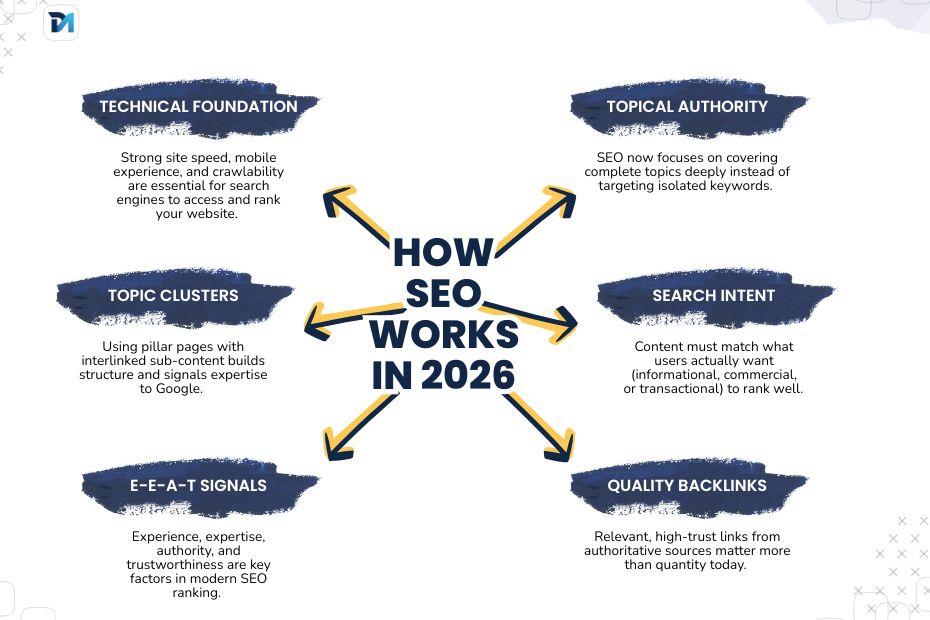
1. Search Intent First: Before targeting any keyword, ask — why is someone searching this? Are they trying to learn (informational), find a site (navigational), compare options (commercial), or buy (transactional)? Your content format must match the intent perfectly.
2. Topic Clusters, Not Single Keywords: Build content hubs. A pillar page covers a broad topic comprehensively. Cluster content covers specific sub-topics in depth. Internal links connect them. This hub-and-spoke model is one of the most powerful things you can do for SEO.
3. Long-Tail, High-Intent Keywords: “SEO” is nearly impossible to rank for. But “best SEO company for e-commerce in Pune” has far lower competition, much clearer commercial intent, and converts at 10× the rate. That’s where real wins are made.
One of the most underused keyword strategies is the People Also Search For (PASF) feature on Google. Our guide breaks down how to use PASF to find content gaps your competitors are completely missing. It’s a goldmine for long-tail discovery.
The Anatomy of a Page That Ranks
| Element | Best Practice | Why It Matters |
|---|---|---|
| Title Tag | 60 characters, keyword-natural, click-worthy | Primary CTR driver in search results |
| Meta Description | 155 characters, written like ad copy | Not a ranking factor, but directly lifts CTR |
| H1 Tag | One per page, includes primary keyword | Strongest on-page topic signal |
| H2 / H3 Subheadings | Use semantic & question-format keywords | Featured snippet candidates & AI answer sources |
| Opening Paragraph | State who page is for & what it covers | Google reads this to confirm relevance instantly |
| Internal Links | 3–8 contextual links to related pages | Spreads authority, strengthens content architecture |
| Image Alt Text | Accurate description of every image | Image search rankings + accessibility |
| Content Depth | More complete than top-ranking pages | Comprehensiveness beats length every time |
Content Freshness: The Signal Most Businesses Ignore
Google has a freshness algorithm. For queries where recency matters — news, guides, how-to content, industry trends — recently updated pages get a meaningful boost. We regularly revisit our top-performing content and update it with new data, new examples, and new insights. Even updating a statistic or adding a new FAQ section can revitalize a page that’s been slipping in rankings.
Section 06E-E-A-T: The Authority Signal That Separates Leaders from Everyone Else
If there’s one concept that has changed SEO more than anything else over the past five years, it’s E-E-A-T: Experience, Expertise, Authoritativeness, and Trustworthiness.
In a world full of AI-generated, low-effort content, Google wants to surface content created by real people with genuine experience and demonstrable expertise. Google added the extra “E” for Experience in 2022 — signalling that first-hand, lived knowledge is now a specific quality signal.
What Each Letter Really Means
| Signal | What Google Looks For | How to Demonstrate It |
|---|---|---|
| Experience | Has the author actually done what they’re writing about? | Real case studies, “here’s what happened when we tried this,” first-hand data |
| Expertise | Does the author have qualifications and demonstrated knowledge? | Author credentials, depth of content, technical accuracy, byline visibility |
| Authoritativeness | Do other authoritative sources reference this site? | Backlinks from industry publications, brand mentions, citations in media |
| Trustworthiness | Is the website honest, accurate, and transparent? | SSL, accurate NAP, clear about-us, transparent claims, genuine reviews |
How to Build E-E-A-T — Practical Actions
- Write detailed author bios with credentials, social profiles, and a real photo on every article
- Include real case studies with specific before/after data (with client permission)
- Earn coverage in industry publications, news sites, and credible blogs
- Gather and display genuine Google reviews and third-party testimonials
- Create a thorough About Us page explaining who you are, your history, and credentials
- Cite your sources in content — link out to reputable studies and official data
- Have consistent NAP (Name, Address, Phone) across all online directories
- Build a personal author presence with published work on external sites
Section 07Link Building in 2026: What Actually Works (And What Will Get You Penalized)
Let me tell you what happened to a client we’ll call Rajan. He ran a SaaS company and hired a link-building service promising 50 backlinks/month for ₹8,000. They delivered — 50 links from Pakistani blogs, link farms, and irrelevant directories, every single month.
When Google’s spam update hit, Rajan’s organic traffic dropped 67% overnight. It took us eight months and a painful link disavow process to recover. Eight months of near-zero organic revenue. Don’t be Rajan.
What Makes a Backlink Genuinely Valuable
A backlink’s value comes from one simple test: would a real person on a real website logically link to your content as a useful reference?
| Backlink Attribute | High Value | Low / Harmful |
|---|---|---|
| Domain Trust | Established news sites, universities, industry authorities | New domains, link farms, irrelevant foreign blogs |
| Topical Relevance | Marketing blog → marketing agency | Cooking site → SaaS company |
| Link Placement | Natural editorial in body content | Footer, sidebar, blogroll |
| Anchor Text | Natural, varied — brand name, URL, related phrases | Over-optimized exact match × 100 = red flag |
| Link Velocity | Gradual, consistent growth | 100 links in one week then nothing |
Link Building Tactics That Work in 2026
Section 08Local SEO: How to Dominate “Near Me” Searches in Your City
If your business serves customers in a specific geographic area — whether you’re a restaurant, law firm, clinic, or service provider — local SEO is arguably the highest-ROI marketing activity available to you.
One of our clients, a dental practice in Gurgaon, was spending ₹40,000/month on Google Ads to drive appointment bookings. We ran a 4-month local SEO campaign alongside the ads. By month 5, local SEO was driving twice the monthly bookings of the paid campaign — at a fraction of the ongoing cost.
Google Business Profile (GBP) Optimization
Your GBP listing is the single most important local SEO asset you have. It often appears above organic results for local queries. Optimization checklist:
- Complete every field — business name, category, address, phone, website, hours
- Write a keyword-rich, compelling business description (750 characters)
- Add high-quality photos: exterior, interior, team, products/services
- Enable Google Messaging for instant customer contact
- Post weekly updates — offers, news, events
- Actively gather and respond to Google Reviews — every single one
- Add your service areas and full service menu
Local Citations & NAP Consistency
Citations are online mentions of your business Name, Address, and Phone (NAP). Google cross-references these across directories to verify your business is legitimate. Inconsistencies — even “Street” vs “St.” — create confusion and hurt local rankings.
Key citation sources for Indian businesses: JustDial, IndiaMart, Sulekha, Yellow Pages India, Bing Places, and your local chamber of commerce.
🗺️ We offer dedicated local SEO services for businesses across Delhi, Mumbai, Bengaluru, Pune, and 20+ Indian cities.
Get Free Local SEO Audit →Section 09The ROI of SEO: Why Organic Traffic Is Your Best Long-Term Investment
This is the conversation I most enjoy having with CFOs and cost-conscious founders. Because when you actually run the math, SEO is not a “marketing expense” — it’s a capital asset that appreciates over time.
SEO vs. Paid Ads: The Real Math
| Factor | SEO (Organic) | Google Ads (PPC) |
|---|---|---|
| Time to first results | 3–6 months | Immediate |
| When you stop paying | Traffic continues compounding | Traffic drops to zero instantly |
| Cost per click over time | Decreases as assets compound | Increases with competition |
| CTR at top position | ~27.6% (organic #1) | ~1–3% (ad label reduces trust) |
| User trust | High — users trust organic results | Lower — “Ad” label creates scepticism |
| Lead close rate | 14.6% | Varies widely by industry |
| Value at Year 3 | Compounding asset — massive ROI | Spent 3× more for the same traffic |
The Compounding Effect: Why SEO Gets Better Over Time
A paid ad campaign is linear — you get what you pay for, nothing more. SEO is exponential. Every quality piece of content you publish:
- Ranks for its target keyword (primary traffic)
- Captures long-tail variants Google finds relevant — often 3–5× the primary traffic
- Earns backlinks over time as it gets discovered (ongoing authority boost)
- Supports other pages through internal linking (rising tide effect)
- Grows fresher authority as it’s updated (freshness signal)
A piece of content published today might have its best traffic in year three — not month one. That’s not a bug. That’s SEO’s most powerful feature.
The “Cheap SEO” Trap: Why hiring the wrong SEO company in India could cost you everything — our most uncomfortable article and one of our most important. Read it before signing any SEO contract.
Section 10How to Choose the Right SEO Partner in India
India has more SEO agencies per capita than almost anywhere in the world. The market is enormous, fragmented, and — frankly — riddled with bad actors making promises they can’t keep. Here’s how to evaluate any SEO partner, including us.
Green Flags — Signs of a Genuine SEO Partner
- They audit your website before making any promises or proposing a strategy
- They explain their strategy in plain language and show you the reasoning
- They set realistic timelines — 3–6 months for initial results, 12+ months for compounding growth
- They report on business metrics (leads, revenue) — not just vanity keyword rankings
- They have verifiable client case studies with real businesses and real data
- They have a clear content strategy — SEO without content is just technical maintenance
- They communicate proactively about algorithm updates and strategy adjustments
Red Flags — Run Away From Anyone Who…
- Guarantees #1 rankings on Google — nobody can guarantee this, not even Google
- Promises competitive results in 30 days
- Won’t disclose the specific tactics and links they’ll build
- Offers massive quantities of backlinks at suspiciously cheap prices
- Reports only on keyword rankings and never on traffic, leads, or revenue
- Uses the same template strategy for every client regardless of industry or competition
- Can’t explain specifically which pages they’ve improved, or why
For specific interview questions to ask any SEO agency before signing, read: Why Hiring the Right SEO Expert Can Make or Break Your Online Growth.
See Exactly What’s Holding Your Website Back
We’ve audited 500+ Indian websites and know exactly what separates page 1 from the rest. Your free audit includes: Technical health score · Keyword opportunity map · Competitor gap analysis · 6-month growth roadmap.
Section 11Your 90-Day SEO Action Plan: From Zero to Growing
Everything in this guide could feel overwhelming if you try to do it all at once. Don’t. SEO is a priority-ordered sequence, not a simultaneous to-do list. Here’s how I’d approach the first 90 days for any business starting fresh — or restarting after neglect.
Days 1–30: Foundation & Audit Phase
Days 31–60: On-Page Optimization
Days 61–90: Authority Building
By month 3–4 you should see early organic traffic movement. By month 6, meaningful traffic gains. By month 12, the compounding growth becomes hard to ignore. These timelines assume consistent effort on competitive-but-attainable terms — your mileage varies based on niche and domain age.
Section 12Expert FAQ: Every Important SEO Question, Answered
These are the questions we get asked most often — from new clients, founders, and marketing managers who’ve been burned before. Answered with the same directness I’d use if you were sitting across from me in our office.
Ready to Turn Search into Your #1 Growth Channel?
You’ve just read 7,000 words of our best SEO thinking. Now imagine what we can do when we apply it specifically to your business, your competitors, and your market in India.