Search has changed.
It is no longer enough to write for keywords, hope for backlinks, and wait for rankings. In 2026, content is increasingly discovered through AI-powered systems that summarize, compare, and cite information from across the web. That means the real goal of modern SEO is no longer just visibility in search results — it is becoming a source worth referencing.rankscope+1
AI SEO is the practice of creating content that works for both humans and intelligent search systems. It is about writing with clarity, depth, structure, and trust so your content can be understood, surfaced, and cited by Google AI Overviews, ChatGPT Search, Perplexity, and similar tools.seoexperts+1
What AI SEO Really Means
AI SEO is not about stuffing articles with AI-generated text or chasing shortcuts.
It is about building content that answers real questions clearly, demonstrates topical expertise, and presents information in a way that search systems can easily interpret. The strongest AI SEO content is not only optimized for discovery — it is genuinely useful to read.mediajunction+1
That means your blog should do three things well:
- Answer the main question early.
- Explain the topic with depth and structure.
- Include original value that cannot be found in every other article.
If your content does those three things, it has a much better chance of earning attention from both readers and AI systems.foursets+1
Why AI Search Changes Everything
Traditional search was built around matching words.
AI search is built around understanding meaning. A person can now ask a full question, explain their situation, and expect a direct answer instead of ten blue links. That is why content in 2026 must be written more like expert guidance and less like a keyword checklist.youtuberankscope
This shift matters because AI systems do not just pull one page and call it a day. They compare multiple sources, look for consistency, and generate answers based on what seems most trustworthy and helpful. If your content is vague, thin, or repetitive, it becomes easier to ignore. If it is precise and well-structured, it becomes easier to cite.rankscope+1
Google AI Overviews And GEO
One of the biggest changes in search is Google AI Overviews, which present synthesized answers directly in search results. This has created new attention around GEO, or Generative Engine Optimization, which focuses on making content more usable for AI-generated responses.seomafiaclub+1
The mindset shift is simple:
- SEO asks, “How do I rank?”
- GEO asks, “How do I become part of the answer?”
That is why modern content should be written with extractable clarity. Short definition blocks, clean headings, concise explanations, and strong topical relevance all help AI systems understand your page faster.becomingseo+1
Semantic SEO And Entities
Semantic SEO matters more now because AI systems understand context better than older search models.
Instead of repeating one phrase over and over, your content should naturally cover the related ideas around the topic. For example, if you are writing about AI SEO, it makes sense to mention concepts like AI Overviews, ChatGPT Search, Perplexity, GEO, semantic SEO, entities, topical authority, and information gain.resultfirst+1
Entities are the people, brands, products, technologies, and concepts that define a topic. When your blog includes those entities naturally, it becomes easier for search systems to understand what the page is about and how it fits into the wider subject landscape.linksurge+1
Topical Authority Wins
Topical authority is not built by writing one great article.
It is built by creating a connected cluster of useful content around one subject. If your website has one post on AI SEO, another on AI vs SEO, another on SEO vs GEO, and more supporting articles around search, content, and optimization, you signal depth and expertise.authoritystack+1
That is why internal linking matters so much. It helps readers move through related ideas and helps search systems understand the structure of your site. For this blog, natural internal links should point to your related pages below.authoritystack
Recommended Internal Links
Use these as natural internal links inside the body:
You can place them in a section like this:
If you want to understand the foundation behind this topic, read our guide on AI and SEO.
If you are comparing old and new search strategies, see AI vs SEO.
If you want the broader strategic picture, our post on SEO vs GEO is a useful next step.
What Makes Content Worth Citing
AI systems prefer content that is easy to verify and useful to summarize.
That means your blog should include:
- Clear explanations.
- Practical examples.
- Original insight.
- Clean formatting.
- A trustworthy tone.
- Supporting references to authoritative sources.static1.squarespace+1
A strong AI SEO article should feel like something written by a subject expert, not by a content spinner. The more specific and grounded your writing is, the more likely it is to hold attention and build trust.mediajunction+1
A Simple AI SEO Workflow
Here is a practical workflow you can follow for every AI-focused blog:
- Start with the real question the reader is asking.
- Write a direct answer in the first paragraph.
- Expand with related concepts and examples.
- Add internal links to relevant supporting pages.
- Add one or two external links to trusted sources.
- Finish with a useful CTA.
This approach works because it balances human readability with AI-friendly structure.static1.squarespaceyoutube
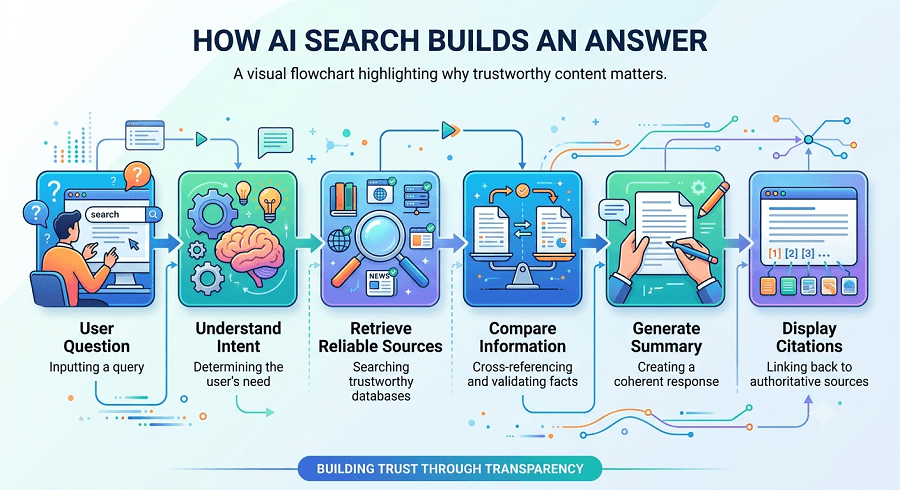
Flowchart showing how AI search systems interpret a question, retrieve sources, compare information, generate a summary, and display citations.
Trusted Resources About AI SEO in 2026:
You do not need to overload the post with outbound links. A few authoritative references are enough to support trust and keep the article clean.seomafiaclub+1
Final Thought
AI SEO is not about tricking systems.
It is about writing content that deserves to be found, read, and referenced. The future belongs to content that is clear, structured, useful, and original enough to stand out in a noisy web. If your blog teaches something genuinely valuable, it will always have a better chance of performing well than content written only to fill space.seoexperts+1
If you want to grow your website with content that is built for both humans and AI search, explore our related guides on AI and SEO, AI vs SEO, and SEO vs GEO.
For help with AI SEO strategy, content planning, or blog writing that builds authority, contact Digimark Sol.