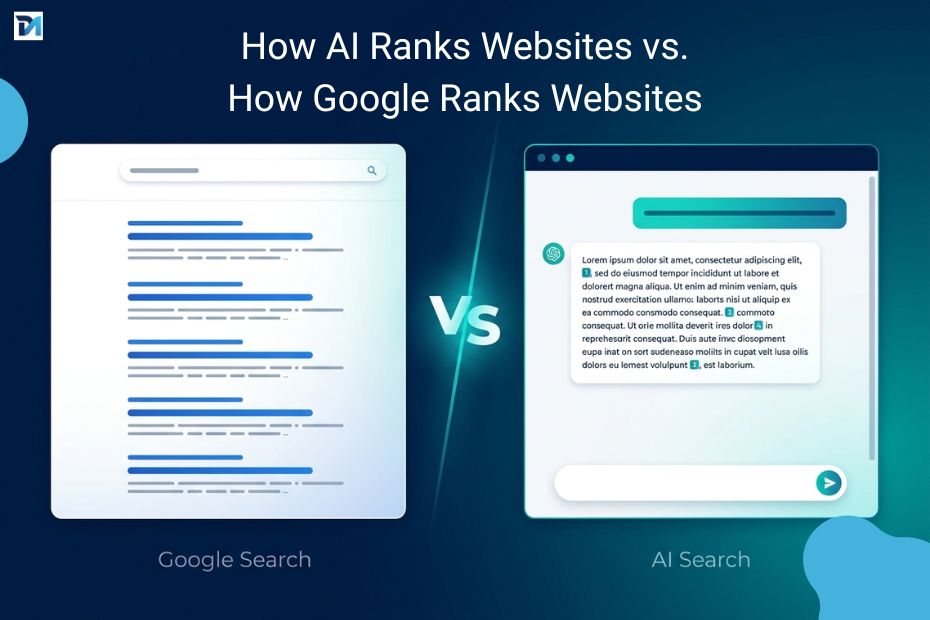
A DigiMark Solutions research brief on the two ranking systems shaping who gets found online — and what to do about it.
For twenty years, “ranking” meant one thing: where your blue link sat on a page of ten. That definition is breaking apart in real time. Today, a page can rank #1 on Google and still get zero traffic, because the answer already appeared in an AI Overview above it. Another page can sit on page two of Google and still get quoted by name in a ChatGPT response read by someone who never opens a browser tab.
Two ranking systems are now running in parallel, and they don’t play by the same rules. One sort of link. The other writes answers. Understanding the difference isn’t an academic exercise anymore — it’s the difference between growing traffic through 2027 and watching it quietly evaporate.
This guide breaks down exactly how each system works, where they overlap, where they diverge sharply, and what a business, SaaS company, or agency should actually do about it. No hype, no “one weird trick.” Just the mechanics, backed by the primary sources — Google’s own documentation, the academic research behind Generative Engine Optimization, and platform-level data from 2026.
Quick definition: Google ranking is the process of crawling, indexing, and scoring web pages so the ten (or so) most relevant, trustworthy results appear as clickable links for a search query. AI ranking is the process an AI system like Google AI Overviews, ChatGPT, Perplexity, or Gemini uses to retrieve, evaluate, and select a small number of sources to synthesize into one written answer — with only some of those sources ever surfacing as a citation.
Table of Contents
- The Big Picture: Two Systems, Two Jobs
- How Google Ranks Websites
- How AI Search Engines Rank Content
- Search Engine vs. Answer Engine: Side-by-Side
- 7 Core Differences Between AI Ranking and Google Ranking
- GEO, AEO, and AIO: What the Acronyms Actually Mean
- What Google Itself Says About Optimizing for AI
- Semantic SEO and Entity SEO, Explained Simply
- The Practical Playbook: Ranking in Both Worlds
- Mistakes We See Businesses Make
- The Future of Search: What to Expect Next
- FAQs
- About the Author & Why Trust DigiMark Solutions
1. The Big Picture: Two Systems, Two Jobs
Google Search, at its core, is still a retrieval and ranking system. Its job is to find the best matching pages for a query and order them. It has done this since 1998, when Larry Page and Sergey Brin built PageRank on a simple idea: a link from one page to another functions as a vote, and votes from authoritative pages count for more. By 1998 Google had indexed roughly 24 million pages using that logic, and outperformed keyword-matching competitors like AltaVista almost immediately.
AI systems — Google’s own AI Overviews and AI Mode, plus ChatGPT Search, Perplexity, Gemini, and Microsoft Copilot — are synthesis systems. Their job isn’t to hand you a list. It’s to read a handful of sources and write you a single, direct answer, citing (some of) the sources it used. Under the hood, this runs on a technique called retrieval-augmented generation, or RAG — the model searches, retrieves passages, and then generates prose grounded in what it found, rather than answering purely from memory.
Think of it this way: a traditional search engine is a librarian who hands you the five best books on a shelf and lets you read them yourself. An AI answer engine is a research assistant who has already read those five books, and hands you a two-paragraph briefing with a couple of footnotes. Both can be useful. But only one of them puts your book directly in the reader’s hands.
Takeaway: Google ranks pages to build a results list. AI systems rank passages to build one answer. That single distinction explains almost every practical difference that follows.
2. How Google Ranks Websites
Google’s ranking process happens in three stages: crawling (discovering pages), indexing (storing and understanding them), and ranking (scoring and ordering them for a specific query). Google has publicly confirmed it uses hundreds of ranking signals, and no single signal decides the outcome — it’s a layered, weighted system that behaves differently depending on the query.
The signal categories that still matter most in 2026
Content quality and relevance. Depth, originality, and how directly a page satisfies the searcher’s intent. Google’s Helpful Content system continues to penalize content built primarily to attract search traffic rather than to help a specific audience.
E-E-A-T (Experience, Expertise, Authoritativeness, Trustworthiness). This isn’t a single ranking factor Google computes directly — it’s a framework baked into Google’s Search Quality Rater Guidelines, the manual used by roughly 16,000 human quality raters to evaluate result quality and feed that judgment back into algorithm training. Google added the second “E,” for Experience, in 2022, formally recognizing that first-hand, lived experience (a product review from someone who actually used the product, for example) can matter as much as academic expertise, especially for “Your Money or Your Life” (YMYL) topics like health, finance, and safety.
Backlinks. Still one of the strongest authority signals two decades after PageRank launched. A link from a relevant, respected industry site or a .edu/.gov domain carries meaningfully more weight than a link from an unrelated directory, and independent large-scale link studies from Ahrefs and Moz have repeatedly found that link relevance and diversity matter more than raw volume.
Core Web Vitals and page experience. Loading speed (LCP), interactivity (INP), and visual stability (CLS) are confirmed ranking inputs, and Cloudflare’s Learning Center offers a useful technical breakdown of how these metrics are actually measured at the network level. A technically broken or painfully slow page can undercut even excellent content.
User interaction signals. Click-through rate, dwell time, and “pogo-sticking” (clicking back to the results page almost immediately) feed systems that adjust rankings based on real searcher behavior over time.
Freshness. Weighted heavily for time-sensitive queries — news, prices, sports scores — and far less for evergreen, conceptual content, a pattern HubSpot’s SEO research team and Search Engine Journal have both documented across large keyword sets.
A simple table: Google’s ranking signal families
| Signal Family | What It Measures | Example |
|---|---|---|
| Content & Intent Match | Does the page actually answer the query, in depth? | A guide that fully explains a topic vs. a thin 300-word post |
| E-E-A-T | Is the creator credible and is the site trustworthy? | Author bios, credentials, transparent sourcing |
| Authority (Backlinks) | Do other credible sites vouch for this page? | A link from an industry publication vs. a spam directory |
| Technical Health | Can Google crawl, render, and serve the page reliably? | Core Web Vitals, mobile usability, HTTPS |
| User Signals | Do real searchers find this result satisfying? | Low bounce-back-to-SERP rate, longer dwell time |
| Freshness | Is the content current for a time-sensitive query? | Recently updated pricing page vs. a stale one |
Expert tip: Most “ranking problems” business owners bring to us aren’t ranking problems at all — they’re crawl or index problems dressed up as ranking problems. Before touching content, we always check whether Google can actually find, render, and trust the page in the first place. Our SEO audit tool is built to catch exactly this.
Takeaway: Google ranking is a scoring competition across hundreds of weighted signals, refined over 25+ years, still anchored in links, relevance, and trust — but now filtered through an AI-assisted layer that decides what to say about the winners.
3. How AI Search Engines Rank Content
This is where most SEO advice from 2022 stops being useful. AI systems don’t produce a ranked list — they produce a synthesized paragraph, and only a fraction of the pages they read ever earn a visible citation.
The general mechanism: retrieval-augmented generation (RAG)
Nearly every AI search product — Google AI Overviews, AI Mode, ChatGPT Search, Perplexity, and Gemini — follows a similar pattern, confirmed directly by Google’s own developer documentation:
- Query decomposition. The system breaks a question into sub-queries. Google calls this “query fan-out” — issuing multiple related searches across subtopics before composing a response, as Google’s documentation explains.
- Retrieval. The system pulls a set of candidate pages from a search index (its own, or a partner’s).
- Filtering and reranking. Candidates are scored for relevance, authority, structure, and freshness. Most are discarded.
- Synthesis. A language model writes a single answer, grounded in the surviving passages.
- Citation. A subset of the sources used in synthesis are surfaced as clickable links — often far fewer than the number of pages actually retrieved.
That last gap matters enormously. Independent analysis of Perplexity, for instance, has found its Sonar system typically visits around ten relevant pages per query but cites only three or four of them in the final answer. Being retrieved is not the same as being cited — and being cited is the only outcome that actually delivers visibility. Google itself confirms, in its consumer help documentation on AI Overviews, that these features are a core part of Search rather than an opt-in experiment, which is part of why the retrieval-to-citation gap matters at scale.
How the major AI platforms differ
They are not interchangeable, and content that gets cited on one frequently disappears on another.
- Google AI Overviews / AI Mode run on Google’s own Search index and core ranking systems, using RAG as a “grounding” layer on top of traditional ranking — meaning a page generally needs to already be indexed and eligible to appear in regular Search results before it can appear as a supporting AI Overview link.
- ChatGPT Search leans heavily on Google’s own search results during live browsing. A February 2026 analysis by SEO researcher Lily Ray found that sites hit by a Google ranking drop saw ChatGPT citations fall by roughly 27.8% — a steeper decline than Google’s own AI Mode citations (about 23.8%) experienced for the same sites, suggesting a fairly direct pipeline from Google’s index into ChatGPT’s citation behavior.
- Perplexity runs its own retrieval pipeline (reportedly drawing on sources like the Brave Search API rather than scraping Google), which is why the same study found Perplexity citations barely moved for sites that lost Google rankings — roughly a 2.9% shift. Perplexity also weighs freshness heavily and, according to citation studies, tends to favor recent, community-driven sources like Reddit threads far more than ChatGPT does, which leans toward Wikipedia and established editorial sources.
- Overlap between platforms is surprisingly low. One 2026 citation analysis found only about 11% of domains cited by ChatGPT were also cited by Perplexity for comparable queries — meaning a brand can be prominent in one AI engine and invisible in another with no change to its content at all. Search Engine Land’s coverage of 2026 clickstream research and Semrush’s analysis of Google’s own AI guidance are both useful primary-adjacent references for tracking how quickly this landscape keeps shifting.
Comparison: How the major AI engines source and cite
| Platform | Retrieval Source | Citation Style | Notable Bias |
|---|---|---|---|
| Google AI Overviews / AI Mode | Google’s Search index (grounded via RAG) | Supporting links below/alongside the summary | Requires normal Search eligibility first |
| ChatGPT Search | Live web browsing, closely tracking Google’s own results | Inline numbered citations | Favors Wikipedia and established editorial sources |
| Perplexity | Its own index plus real-time retrieval (reported to use sources like Brave Search) | Inline citations, cites ~3–4 of ~10 pages visited | Favors freshness and community sources like Reddit |
| Microsoft Copilot / Bing | Bing’s index | Inline citations | Similar RAG pattern to Google’s approach |
Takeaway: There is no single “AI algorithm” to optimize for. There are several, each with its own retrieval source, its own citation behavior, and its own bias — which means a durable AI visibility strategy has to account for more than one system at once.
4. Search Engine vs. Answer Engine: Side-by-Side
| Traditional Search Engine (Google Search) | AI Answer Engine (AI Overviews, ChatGPT, Perplexity) | |
|---|---|---|
| Output | A ranked list of ten+ links | One synthesized written answer |
| Success metric | Position (#1–10) | Whether you’re cited at all |
| User action | Click through to a website | Read the answer, often without clicking |
| Core mechanism | Crawl → Index → Rank | Retrieve → Filter → Synthesize → Cite |
| Primary authority signal | Backlinks + E-E-A-T | Extractability, clarity, citations/statistics in your content |
| Freshness weighting | Query-dependent | Often weighted very heavily (especially Perplexity) |
| Content unit evaluated | Whole page | Individual passage or sentence |
| Visibility without a click | Rare (snippets aside) | Common — brand mentions and citations without traffic |
Takeaway: Optimizing for position on a results page and optimizing for citation inside a written answer are related but genuinely different disciplines — and increasingly, businesses need to do both.
5. 7 Core Differences Between AI Ranking and Google Ranking
1. A list of options vs. one collapsed answer
Google ranking is comparative — you’re judged against nine other results, and being #4 still gets you a visible link. AI ranking is exclusionary — either your content is judged the best passage to quote, or it’s invisible, no matter how well it would have ranked on a traditional SERP.
2. Position vs. citation
On Google, moving from position 8 to position 3 is a meaningful win. In an AI answer, there’s no position — only in or out. This is why some SEO professionals describe AI visibility as binary rather than a spectrum.
3. Whole-page authority vs. passage-level extractability
Google mostly evaluates a page holistically. AI systems evaluate individual passages — a specific paragraph with a clear definition, a clean statistic, or a direct answer to a sub-question is what actually gets lifted into a synthesized response. A page can rank well on Google for its overall depth while contributing zero citable passages to an AI answer.
4. Static index vs. real-time retrieval
Google’s index updates on its own crawl schedule. Several AI engines — Perplexity in particular — perform live retrieval at query time, which is why freshness can matter more for AI citation than it does for a stable, evergreen Google ranking.
5. One algorithm vs. several, each with its own bias
There’s one Google Search ranking system (with many sub-systems). There are several distinct AI engines, each pulling from different indexes, weighting freshness and authority differently, and citing different types of sources — which is why the same content can perform completely differently across ChatGPT, Perplexity, and Google’s own AI Overviews.
6. Clicks vs. zero-click exposure
By mid-2026, roughly two-thirds of U.S. Google searches were ending without any click to an external website, according to clickstream research firm SparkToro — and that rate climbs even higher when an AI Overview appears on the page. AI-only platforms push this further still: reported zero-click rates for AI-native search products range from roughly 60% up to the low 90s depending on the study and query type. Ranking well in a Google sense increasingly does not guarantee a visit. Being cited in an AI answer increasingly is the visit-equivalent — brand exposure without a click.
7. E-E-A-T matters in both — but is demonstrated differently
Google infers E-E-A-T partly through off-page signals: backlink profiles, brand mentions, domain history, third-party reputation. AI systems, per the research behind Generative Engine Optimization, respond more directly to on-page trust signals — cited sources, specific statistics, named expert quotes, and confident, unambiguous language — because those are the exact features a language model can extract and reuse as evidence.
Callout — Why this matters for budget decisions: If your team is optimizing purely for Google position, you may be leaving AI citation opportunities on the table, because the two systems reward slightly different content features. A genuinely comprehensive strategy treats “ranks well” and “gets cited well” as two separate (overlapping) goals — not one.
Takeaway: The differences aren’t cosmetic. They change what “winning” looks like, what content structure earns visibility, and how you’d even measure success.
6. GEO, AEO, and AIO: What the Acronyms Actually Mean
- GEO — Generative Engine Optimization. The practice of structuring content so generative AI systems retrieve, quote, and cite it. The term was coined in the paper “GEO: Generative Engine Optimization” by Aggarwal, Murahari, Rajpurohit, Kalyan, Narasimhan, and Deshpande — researchers from Princeton, Georgia Tech, IIT Delhi, and the Allen Institute for AI — presented at the ACM SIGKDD 2024 conference.
- AEO — Answer Engine Optimization. A closely related, often interchangeable term describing optimization specifically for platforms that generate direct answers (AI Overviews, ChatGPT, Perplexity) rather than link lists.
- AIO — AI Optimization. A broader umbrella term some agencies use to cover both GEO and AEO practices together.
Both Microsoft, through its Bing Webmaster resources, and OpenAI, through its developer documentation, have published guidance touching on how their respective systems retrieve and ground web content — reinforcing that the underlying mechanics (crawlability, structured content, clear sourcing) are consistent across vendors even as citation behavior differs.
What the Princeton research actually found
The GEO study tested nine distinct content tactics across roughly 10,000 queries and multiple generative engines, measuring their effect on a source’s “visibility” in AI-generated answers. Three tactics consistently outperformed the rest:
- Cite Sources — referencing credible, verifiable sources within the content.
- Statistics Addition — including specific, relevant data points rather than vague claims.
- Quotation Addition — including direct expert quotations.
According to the paper’s own reported figures, these top techniques produced roughly 30–40% relative improvements on the study’s visibility metrics compared to unoptimized content, and combining techniques generally outperformed applying any single one alone. By contrast, the researchers found that old-school tactics like keyword stuffing performed poorly or even backfired in generative engine evaluation — a notable contrast with early-2000s SEO.
Definition box: What actually makes content “citable”
For a passage to be extractable and citable by a generative engine, it generally needs to:
- State a clear, direct answer early, in plain language
- Attach a specific number, date, or verifiable fact where relevant
- Attribute claims to a named, credible source
- Avoid hedging language (“might,” “could possibly,” “it seems”) — AI systems have been observed favoring confident, unambiguous phrasing over uncertain claims
- Stand on its own as a self-contained statement, without requiring the reader to have read three paragraphs before it to make sense
This lines up closely with what Backlinko’s content research has long recommended for featured-snippet optimization, and with Nielsen Norman Group’s usability research on how readers (and, it turns out, extraction systems) scan for the direct answer first.
Takeaway: GEO isn’t a rebrand of SEO with a trendier name — it’s a distinct, research-backed discipline focused on passage-level extractability rather than whole-page ranking, and the tactics that work are measurably different from classic on-page SEO.
7. What Google Itself Says About Optimizing for AI
This is the part most “AI SEO” content skips, and it matters more than any third-party opinion, including ours.
On May 15, 2026, Google published its first official guide dedicated to this exact question, titled “Optimizing your website for generative AI features on Google Search,” announced by Google’s Search Relations team and now housed in Google Search Central’s documentation. Google’s own position is refreshingly direct:
- There is no separate AI ranking algorithm to game. Google states plainly that AI Overviews and AI Mode are “rooted in our core Search ranking and quality systems” and that existing SEO fundamentals remain relevant.
- No special technical requirements exist. To be eligible as a supporting link in AI Overviews or AI Mode, Google confirms a page simply needs to be indexed and eligible to appear in normal Search with a snippet — nothing extra.
- Google explicitly discourages several popular “AI SEO hacks.” According to reporting on the guide, Google specifically calls out tactics like publishing standalone llms.txt files or artificially “chunking” content purely for AI consumption as unsupported by how its systems actually work.
- Google names GEO and AEO directly — and frames them as different labels for the same underlying discipline: “optimizing for the search experience,” which it still considers SEO.
- The one thing Google says actually matters more under AI features: producing genuinely non-commodity content — a unique perspective, first-hand experience, and expert depth that a generative model can’t simply reconstruct from ten other similar pages.
Google Search Console has also begun rolling out generative AI performance reporting (introduced in June 2026), giving site owners visibility into how their pages perform specifically within AI-powered results — a metric that simply didn’t exist as a native Google reporting feature before 2026.
Expert tip: Google’s own guidance is useful precisely because it’s boring. There’s no shortcut it’s hiding. The pages that show up in AI Overviews are, overwhelmingly, the same pages that were already doing fundamentally sound SEO — comprehensive, well-sourced, technically clean, genuinely useful. AI features raise the bar on originality; they don’t replace the fundamentals.
Takeaway: According to Google’s own documentation, AI visibility isn’t a separate game with separate rules — it’s the same SEO fundamentals, applied with an even sharper focus on first-hand expertise and content no one else can replicate.
8. Semantic SEO and Entity SEO, Explained Simply
Both Google’s ranking systems and AI answer engines have moved well past matching exact keywords. Two related concepts explain how modern systems actually understand content:
Semantic SEO is optimizing for the meaning behind a query, not just its exact wording. Google’s RankBrain and BERT systems, and the neural matching layer behind them, interpret intent and context — so a page about “budget-friendly running shoes for flat feet” can rank for “cheap shoes for overpronation” even without that exact phrase appearing anywhere on the page.
Entity SEO is optimizing around things — recognizable, well-defined concepts, people, organizations, and products — rather than strings of text. Google (and AI systems trained similarly) increasingly understand your brand, your founder, and your product as connected “entities” in a knowledge graph, associated with structured facts. This is why consistent naming, structured data (via Schema.org markup), and clear “about” and author pages compound in value: they help systems confirm who is behind the content and what it’s actually about, at the entity level rather than the keyword level.
Structured data doesn’t guarantee inclusion in AI answers, but it remains one of the clearest, lowest-risk ways to make a page’s facts machine-readable — for Google, and for any AI crawler reading the same markup. The underlying web standards behind this markup are maintained by the World Wide Web Consortium (W3C), which continues to shape how structured data is defined across the open web.
Takeaway: Write for concepts and entities, not keyword density. Both ranking systems have moved toward understanding meaning and identity — writing to satisfy a keyword-matching algorithm from 2010 actively works against you in 2026.
9. The Practical Playbook: Ranking in Both Worlds
You don’t need two separate content strategies. You need one strategy that satisfies both systems’ actual priorities, because they overlap more than they conflict.
For Google ranking:
- Build genuinely comprehensive, intent-matching content — not the longest post, the most complete one
- Earn backlinks from relevant, credible sites rather than chasing volume
- Fix Core Web Vitals and mobile usability before touching content
- Demonstrate E-E-A-T with visible author credentials, transparent sourcing, and real first-hand experience
For AI citation (GEO/AEO):
- Answer the core question in the first 1–2 sentences of each section, in plain language
- Attach a specific statistic or verifiable fact to key claims, with clear attribution
- Use definition boxes, numbered steps, and comparison tables — structures generative engines can extract cleanly
- Include direct, well-attributed quotes from real experts (a named person with a title, not “experts say”)
- Update time-sensitive content regularly — freshness weighs heavily for engines like Perplexity
- Maintain consistent entity information (brand name, author names, organization details) across your site and structured data
Shared foundation (do this regardless of platform):
- Technical health: crawlable, indexable, fast, secure
- Genuine subject-matter depth that a generic AI-written competitor page can’t replicate
- Clear, unambiguous writing — confident statements outperform hedged ones in both systems
- Consistent publishing and updating cadence
A short, actionable checklist
Audit technical SEO health (crawlability, Core Web Vitals, mobile) — try our free SEO Audit Tool
Add named author bios with real credentials to key pages
Identify your 10 highest-value pages and add a specific statistic + source to each
Add one direct, attributed expert quote to your three most important pages
Implement Article, FAQ, Organization, and Author schema markup
Build a content freshness calendar for anything time-sensitive
Set up Search Console’s generative AI performance report and track it monthly
Check citation presence across Google AI Overviews, ChatGPT, and Perplexity for your top 20 queries
If building and maintaining this across a real content library feels like a lot to track — it is. It’s a large part of what our SEO Services and Technical SEO teams do for clients week to week.
Takeaway: Most of what earns AI citation is simply excellent SEO practiced with unusual discipline — plus a handful of specific, research-backed additions like statistics, attribution, and structured extractability.
10. Mistakes We See Businesses Make
Chasing “AI SEO hacks” Google has publicly disavowed. Publishing a standalone llms.txt file or obsessively “chunking” content for AI consumption isn’t supported by how Google’s systems work, according to Google’s own documentation — yet it remains one of the most commonly sold “AI SEO” services.
Treating all AI platforms as one target. Optimizing only for what shows up in Google AI Overviews and assuming ChatGPT or Perplexity will follow is a mistake — the citation overlap between platforms can be as low as roughly 11%, according to 2026 citation research.
Publishing vague, hedged claims. “Studies suggest this might help” is far less citable than a specific, attributed statistic. Confidence and specificity are functionally rewarded by extraction-based systems.
Ignoring technical SEO because “AI doesn’t need it.” AI Overviews still require a page to meet standard Search indexing eligibility first. A technically broken page is invisible to both systems, not just one.
Measuring success purely by click-through traffic. In a world where a large share of queries end in zero clicks, brand mentions and citations inside AI answers are a real, measurable form of visibility and demand generation — even without a session in Google Analytics. Track branded search volume and AI citation presence alongside traditional traffic.
Publishing generic, “commodity” content. If a generative model could write your page from ten other similar pages, it doesn’t need to cite yours. Original data, first-hand testing, and a genuine point of view are the only durable moat left.
Takeaway: Nearly every mistake on this list comes from optimizing for last decade’s system, ignoring the platform’s own stated guidance, or chasing a shortcut that Google has explicitly said doesn’t work.
11. The Future of Search: What to Expect Next
A few trends are already visible heading into 2027:
- Query volume inside AI experiences is growing fast. Google reported at its May 2026 I/O event that AI Mode had surpassed 1 billion monthly users, with query volume more than doubling each quarter.
- Zero-click search will keep rising, not reverse. Multiple independent studies place the overall Google zero-click rate in the mid-to-high 60% range in 2026, up steadily from roughly 50% in 2019 — a trend that predates generative AI and is now accelerating alongside it.
- Agentic search is emerging. Beyond answering questions, AI systems are increasingly built to take actions — booking, purchasing, filling forms — which raises the importance of structured, machine-readable data (schema markup, product feeds, clean APIs) for any business that wants to be considered by an AI agent, not just an AI answer.
- Measurement is catching up. Google Search Console’s new generative AI performance reporting signals that platforms are starting to formally acknowledge AI visibility as a distinct, trackable metric rather than an unmeasured side effect.
- The premium on original expertise will keep rising. As generative content becomes cheaper to produce at scale, both Google’s ranking systems and AI citation behavior increasingly reward what a machine can’t fabricate on its own: real experience, proprietary data, and a genuine point of view.
Takeaway: The direction of travel is consistent across every data point available: less clicking, more synthesized answering, and a growing reward for content that couldn’t have been written by the AI reading it.
12. Frequently Asked Questions
1. What is the main difference between how AI ranks websites and how Google ranks websites? Google ranking sorts entire web pages into a list of links based on relevance, authority, and trust signals. AI ranking retrieves and evaluates individual passages, then synthesizes a subset of them into one written answer, citing only a fraction of what it reviewed. One produces a list; the other produces an answer.
2. Does Google use a different algorithm for AI Overviews than for regular search? No. According to Google’s own documentation, AI Overviews and AI Mode are built on Google’s core Search ranking and quality systems, with a retrieval-augmented generation layer added on top. A page must already be eligible to appear in normal Search results before it can be used as a supporting link in an AI Overview.
3. What does GEO (Generative Engine Optimization) mean? GEO is the practice of structuring content so generative AI systems are more likely to retrieve, quote, and cite it. The term originates from a 2024 Princeton-led research paper that tested nine content tactics and found that adding citations, statistics, and direct quotations produced the largest measurable gains in AI visibility.
4. Is GEO the same as AEO? They’re closely related and often used interchangeably. GEO (Generative Engine Optimization) tends to describe optimizing for AI-generated synthesis broadly, while AEO (Answer Engine Optimization) emphasizes optimizing for platforms built specifically to answer questions directly. Google’s own documentation treats both as different names for the same underlying practice: optimizing the search experience.
5. Do backlinks still matter for AI search visibility? Backlinks remain a major Google ranking signal and indirectly support AI visibility by strengthening a site’s overall authority and reputation. However, generative engines appear to weigh on-page extractability — clear statistics, direct quotes, unambiguous statements — more heavily than backlink count when deciding what to cite in a specific answer.
6. Why does the same content get cited by ChatGPT but not by Perplexity? The two platforms run different retrieval pipelines. ChatGPT’s citation behavior tracks closely with Google’s own search results, while Perplexity runs its own retrieval system and weighs freshness and community sources like Reddit more heavily. Research in 2026 found the domain overlap in citations between the two platforms was as low as roughly 11%.
7. What is retrieval-augmented generation (RAG)? RAG is the technique most AI search systems use to ground their answers in real, current content instead of relying only on a model’s training data. The system retrieves relevant passages from a live or recent index, then generates an answer based on what it found, typically citing the sources it used.
8. Does keyword stuffing help with AI search rankings? No. Research behind Generative Engine Optimization found that old-school tactics like keyword stuffing performed poorly, and sometimes worse than doing nothing, when tested against generative engines. Clear, specific, well-attributed writing performed significantly better.
9. What is E-E-A-T and does it apply to AI search too? E-E-A-T stands for Experience, Expertise, Authoritativeness, and Trustworthiness — a framework in Google’s Search Quality Rater Guidelines used to judge content and creator credibility. It isn’t a single automated ranking factor, but it shapes many of the signals Google’s systems use. AI systems reward similar underlying qualities, though they infer them more from visible on-page trust signals (citations, named experts, transparent sourcing) than from off-page reputation alone.
10. Should I stop optimizing for traditional Google rankings and focus only on AI search? No. Google Search still drives the large majority of organic web traffic, and its own AI features are built on the same underlying ranking systems. The two disciplines overlap far more than they conflict — strong technical SEO, genuine expertise, and clear structure benefit both.
11. What is Google AI Mode and how is it different from AI Overviews? AI Mode is a more conversational, deeper AI search experience within Google Search, allowing users to move from a quick AI Overview into a back-and-forth dialogue while retaining the context of their original question. Google announced at its May 2026 I/O event that AI Mode had surpassed 1 billion monthly users.
12. Do I need an llms.txt file to rank in AI search? According to Google’s own guidance, no. Google has specifically named the creation of standalone llms.txt files as a tactic not supported by how its systems actually work, alongside artificially chunking content purely for AI consumption.
13. What percentage of searches now end without a click? Estimates from multiple 2026 studies place the overall Google zero-click rate in the mid-to-high 60% range, up from around 50% in 2019, with the rate climbing further when an AI Overview appears on the results page. AI-native platforms report even higher zero-click rates for many query types.
14. What is Entity SEO? Entity SEO is the practice of optimizing content around recognizable people, organizations, products, and concepts (entities) rather than isolated keywords, helping search and AI systems understand who and what a piece of content is really about — often reinforced through structured data like Schema.org markup.
15. How can I track whether my content is being cited by AI search engines? Google Search Console began rolling out generative AI performance reporting in June 2026. Beyond that, manual spot-checks — running your target queries directly in Google AI Overviews, ChatGPT, and Perplexity and noting which sources are cited — remain a practical, low-cost way to monitor AI visibility.
16. Does content freshness matter more for AI search than for Google search? It depends on the platform and query type. Freshness has always mattered for time-sensitive Google queries. For AI engines that perform live retrieval at query time, particularly Perplexity, freshness appears to carry outsized weight even for topics that aren’t traditionally considered “news.”
17. Can small businesses realistically compete with large brands in AI search? In some respects, yes, more easily than in traditional SEO. Because generative engines reward clear structure, genuine expertise, and extractable, well-sourced content over raw domain size, a small, focused site with real first-hand experience can be cited alongside — or instead of — a much larger competitor for the right query.
18. What is the single most important thing to do first? Fix the technical foundation. Neither Google nor any AI system can rank or cite a page it cannot crawl, index, or trust — so crawlability, indexing, and basic E-E-A-T signals should come before any GEO-specific tactic.
About the Author & Why Trust DigiMark Solutions
This guide was researched and written by Vivek Sharma and the SEO strategy team at DigiMark Solutions, an SEO agency working with SaaS companies, startups, and established businesses navigating the shift from traditional search to AI-powered search. Vivek and the team draw on hands-on experience running technical audits, backlink campaigns, and content strategy across hundreds of client engagements — and, increasingly, on first-hand testing of what actually gets cited across Google AI Overviews, ChatGPT, and Perplexity for real client queries.
Our approach to this topic in practice: we don’t sell “AI SEO hacks.” We test what Google says, we test what independent researchers have measured, and we build recommendations around what actually holds up — including telling clients when a tactic (like a standalone llms.txt file) isn’t worth their time, even when a competitor agency is selling it.
If your team is trying to figure out where you currently stand – in Google’s rankings and in AI citations, our free SEO Audit Tool is a good starting point, and our case studies walk through how we’ve applied this exact framework for real clients. For a deeper conversation about your specific situation, you can book a consultation or browse more research on our blog.